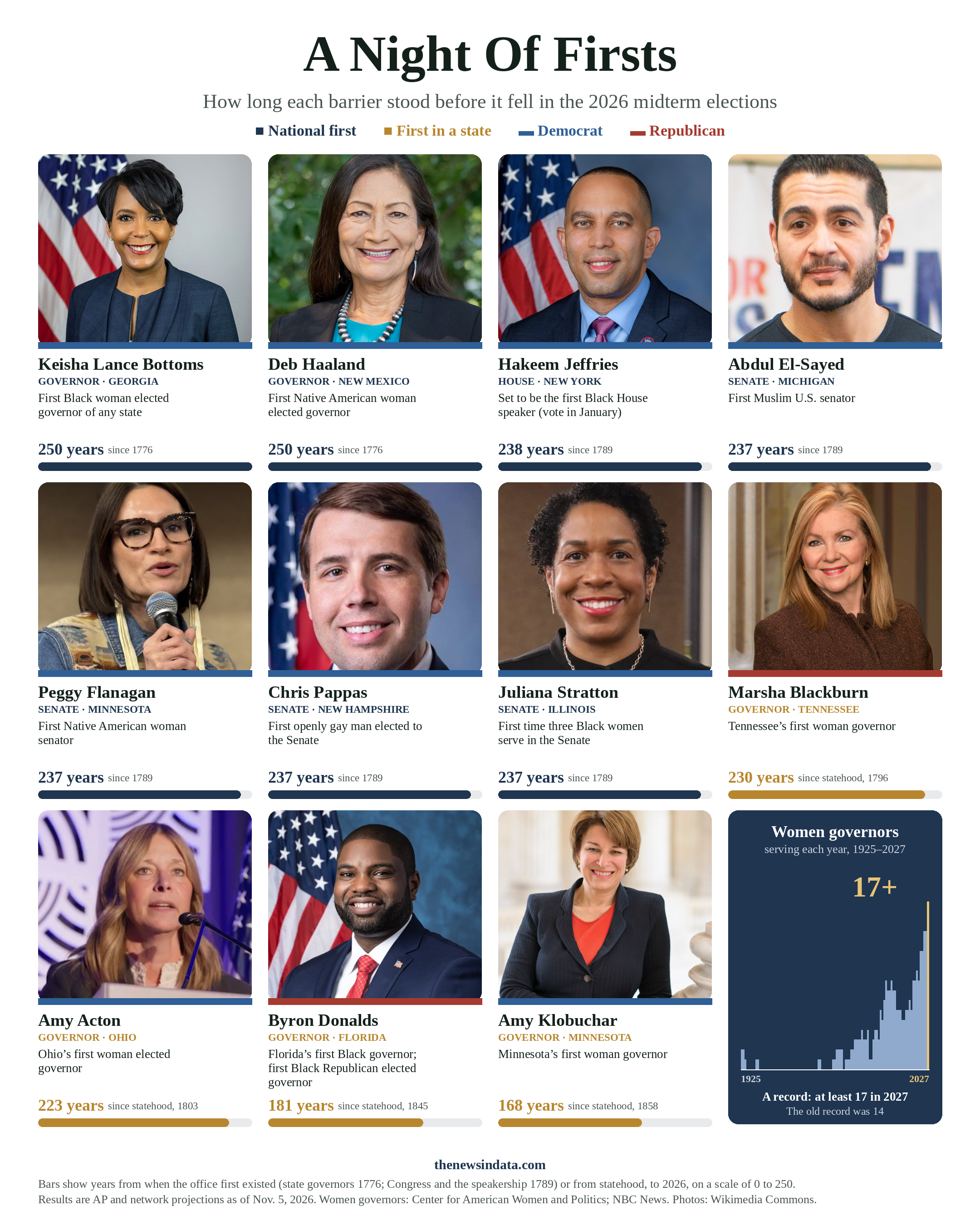
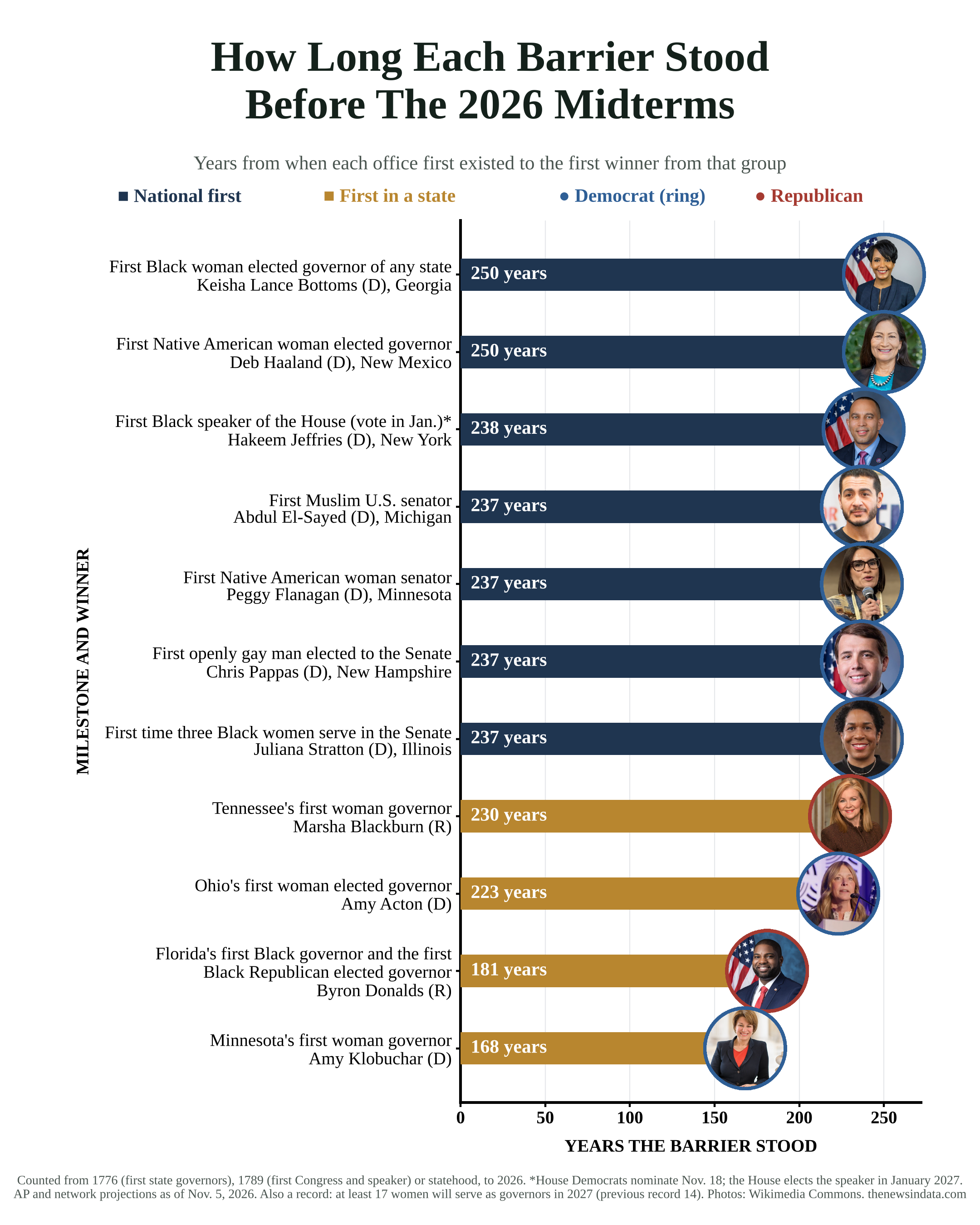
Americans broke a long list of barriers on Tuesday. Georgia elected Keisha Lance Bottoms, the first Black woman to win a governor's race in any state. Florida elected Byron Donalds, the first Black Republican ever elected governor. Michigan sent Abdul El-Sayed to the Senate as its first Muslim member, and at least 17 women will serve as governors next year, beating the record of 14. Some of these barriers had stood since the first state governors took office in 1776.
Firsts on both sides of the aisle
The milestones crossed party lines. Bottoms, a Democrat and former Atlanta mayor, ended 24 years of Republican control of Georgia's governorship and becomes the state's first woman and first Black governor. Donalds, a Republican congressman, becomes Florida's first Black governor, 181 years after statehood. Republican Marsha Blackburn becomes Tennessee's first woman governor; both major-party nominees there were women, so the state was certain to make history.


With Wes Moore re-elected in Maryland, three elected Black governors will serve at the same time for the first time. Only five Black governors have ever been elected: Douglas Wilder in Virginia in 1989, Deval Patrick in Massachusetts in 2006, Moore in 2022, and now Bottoms and Donalds.
A record for women governors
At least 17 women will lead states in 2027, according to NBC News, up from a record of 14 set in 2025. That includes Minnesota's first woman governor, Amy Klobuchar, Ohio's first woman elected governor, Amy Acton, and Deb Haaland in New Mexico, the first Native American woman elected governor of any state.
As recently as 1995 and 1996, only one woman served as a governor all year. Seventeen states had never had a woman governor before this election, according to the Pew Research Center; Georgia, Tennessee and Minnesota came off that list on Tuesday.


New faces in the Senate
In the Senate, El-Sayed becomes the first Muslim senator in the chamber's 237 years; Muslim Americans have served in the House since Keith Ellison's election in 2006. Peggy Flanagan of Minnesota, a citizen of the White Earth Nation, becomes the first Native American woman senator. Chris Pappas of New Hampshire becomes the first openly gay man elected to the Senate, 14 years after Tammy Baldwin became the first openly gay senator.
Juliana Stratton's win in Illinois means three Black women will serve in the Senate at once, also a first, and makes Illinois the first state represented by two women of color.
A first in the speaker's chair
With Democrats winning the House majority, Hakeem Jeffries of New York formally launched his bid for speaker on Nov. 4. House Democrats choose their nominee in a closed-door vote on Nov. 18, and the full House elects the speaker when the new Congress meets in January, where Jeffries will need a majority of members voting. If elected, he would be the first Black speaker of the House and the 57th speaker since the first was chosen in 1789.


One more first is still being counted. In Alaska, Mary Peltola led Sen. Dan Sullivan 48.2% to 47.9% with about 76% of the expected vote in as of Thursday morning, and the race had not been called; if she wins, she would be the first Alaska Native senator. Mississippi's Senate race was also too close to call, with Scott Colom 49.0% to Sen. Cindy Hyde-Smith's 48.9%.
How we counted: Results are unofficial projections by the AP and network decision desks (NBC News, CBS News) as of the morning of Nov. 5, 2026. "Years the barrier stood" runs from the year the office first existed (state governors 1776, Congress and the speakership 1789) or from statehood, to the 2026 election (2027 for the speaker vote). Women governors are counted in every year they served at any point, using the Center for American Women and Politics list; U.S. territories are excluded, and the 2027 count is a minimum from NBC News. NBC News: record number of female governors. NBC News: historic first for Black governors. CAWP: history of women governors. Download our data (CSV).